

Miniature of a Head Gasket for Renault K9K 1.5 dCi (2001-2011)
Miniature of a Head Gasket for Renault K9K 1.5 dCi (2001-2011) - "F4R" / Yes is backordered and will ship as soon as it is back in stock.
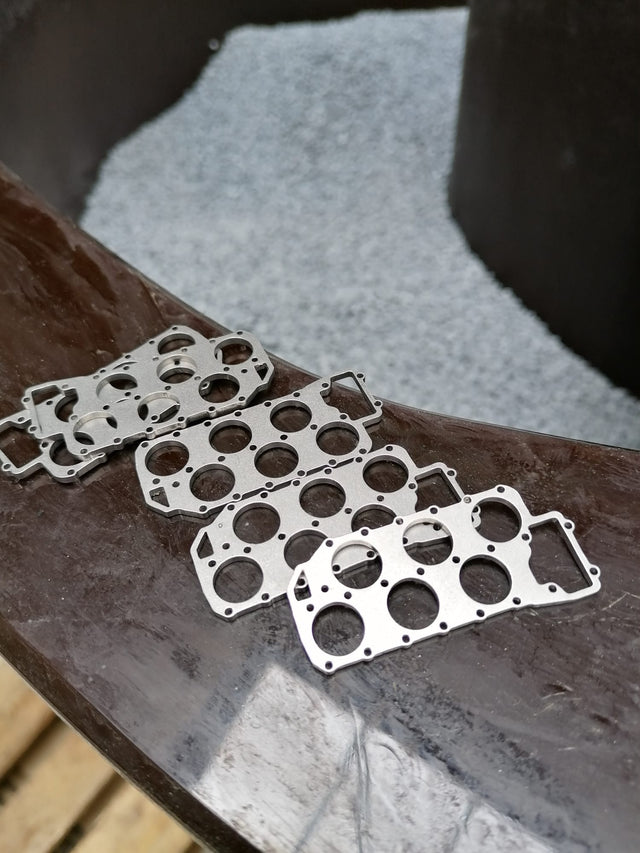
Detailed replica of the K9K head gasket
Detailed replica of the K9K head gasket
Not just "a head gasket as a keychain", but exactly the one for the K9K engine with all the details possible in 65 × 27 × 2 mm size.
Perfect conversation starter for enthusiasts!
Perfect conversation starter for enthusiasts!
Start a conversation with like-minded people who will ask you about your unique keychain!
Safe hit as a gift for the Petrolhead in your life
Safe hit as a gift for the Petrolhead in your life
Show a friend that you really care about him! After all, you even know what engine he has;)
Brushed Stainless Steel. 100% Made in Germany.
Brushed Stainless Steel. 100% Made in Germany.
2mm thick, rigid stainless steel with a handmade brushed surface finish. No mass-produced goods. No cheap junk.
Will be shipped the same day of purchase!
Will be shipped the same day of purchase!
We ship every single working day. All products that are available here in the shop are as well in stock. No delays. No bullshit.
100 days right to return!
100 days right to return!
And we do this without any discussion. That's how convinced we are that we offer cool products.
Size: 65 × 27 × 2 mm
Size: 65 × 27 × 2 mm
Ok, this dropdown is unnecessary. Just wanted to say we heard "it´s a good size" ;)
More info about the K9K
More info about the K9K
Keychain – Head Gasket for Renault K9K 1.5 dCi (early variants up to 2011)
The Renault K9K 1.5 dCi became one of the most widely used small diesel engines of the Renault-Nissan era during the 2000s. This product focuses on the earlier K9K versions up to around 2010, as found in cars such as the Renault Clio II and III, Mégane II, Scénic II, Modus, Kangoo and Twingo II. The same engine family also appeared in numerous Dacia, Nissan and Suzuki models including the Logan, Sandero, Micra K12, Note E11, Qashqai J10, Kubistar and Jimny 1.5 DDiS. With 1,461 cc, four cylinders and outputs ranging from roughly 65 to 106 PS depending on version, the K9K covered everything from economical superminis to compact family cars. Later K9K generations with newer emissions systems and further revisions are deliberately not the focus here.
Technically, the early K9K has a relatively straightforward layout: inline-four architecture, cast-iron block, aluminium cylinder head, SOHC, eight valves, common-rail direct injection, turbocharging and a timing belt. Turbocharger design, injection hardware, intercooling and emissions equipment vary between versions and years. Early 65 and 68 PS units from cars such as the Clio II, Kangoo and Logan are simpler than later 85, 100 and 105 PS versions used in the Mégane II, Scénic II, Clio III and Nissan Qashqai. This is also why parts catalogues and engine stamps use numerous suffix codes including K9K 700, 702, 704, 706, 710, 722, 728, 732, 764, 766 and 796. For experienced owners, those three-digit suffixes can be more useful than the general 1.5 dCi name.
Maintenance and buying discussions around older K9K engines commonly involve the injection system, injectors, high-pressure pump, turbocharger, oil supply, EGR system and timing-belt service. On higher-output versions, a consistent oil-change history is particularly relevant. Some cars already use a diesel particulate filter, while others belong to the simpler Euro 3 or early Euro 4 period. Those differences explain why two cars carrying the same 1.5 dCi badge can have noticeably different hardware and ownership requirements. At the same time, the engine became so widespread across Europe that parts, technical information and long-term experience remain readily available.
For enthusiasts and owners, the K9K connection usually starts with a specific car. A Clio II 1.5 dCi 65 has a very different role from a Mégane II dCi 106, a Jimny 1.5 DDiS or a Qashqai 1.5 dCi, even though they share the same basic engine architecture. Dacia Logan and Sandero models also helped make the engine familiar across many European markets. That is why model names and chassis codes matter almost as much as the engine code for this product: Clio II BB/CB, Clio III BR/CR, Mégane II BM/CM, Scénic II JM, Micra K12, Note E11 and Qashqai J10 are all realistic ways owners may identify their engine.
Whether it lives on your own keys or as a gift for someone with a Clio, Mégane, Dacia, Micra or Jimny 1.5 diesel, this keychain is deliberately tied to the early K9K generation. At first glance the shape is technical and unusual; on second look it can be placed quickly by Renault and diesel enthusiasts. Anyone familiar with codes such as K9K 700, K9K 728 or simply the 1.5 dCi engines of the 2000s will understand the reference.
Proudly crafted in Germany, meticulously detailed and finely finished for a refined in-hand feel paired with a premium brushed surface.

Miniature of a Head Gasket for Renault K9K 1.5 dCi (2001-2011)

Miniature of a Head Gasket for Renault K9K 1.5 dCi (2001-2011) - "F4R" / Yes is backordered and will ship as soon as it is back in stock.
Quality
Why you are not buying cheap mass-produced goods here


Payment and buyer protection
We accept all common payment methods
We attach great importance to the highest level of security for our customers. We do not store any credit card details or similar (and have no access to such data anyway)
Buyer protection
We have the same buyer protection mechanisms in place as the large marketplaces. In the event of a dispute, the customer can usually block the payment. However, the customer is king for us and we have so far solved every problem quickly and through personal contact.